Carlos Alcaraz is a name you will begin to hear more and more often. The young Spaniard, aged 19, is a hot shot on the ATP Tour right now that is combining the weapons of a lethal forehand with a delicate drop shot to take on the world’s best. Having turned pro in 2018, he spent his first few years grafting on the ITF and ATP Challenger Tours with increasing success. Come January 2021 and he made his first ATP Tour appearance in Melbourne, before making Round 2 of the Australian Open, after progressing through Qualifying.
Building upon his experience, he had a good run on clay that saw him break into the Top 100 in May 2021, just before he worked his way through Qualifying to make the main draw and Round 3 of Roland Garros. Only two rounds of grass court tennis at Wimbledon and Alcaraz was back on the dusty clay, winning his first ATP 250 title in Umag, Croatia. This took his ranking to 55 in the world, climbing 100 spots in the last 7 months and almost 400 ranking spots in just one year.
Alcaraz’s progression continued to build on the hard courts as he qualified into the main draw of Cincinnati Masters, made the Semi Finals of ATP 250 in Winston-Salem and the Quarter Finals of the US Open, including his first win against a Top 10 player (Stefanos Tsitsipas) in 5 sets. Alcaraz clocked up a further five wins in Vienna and Paris before winning the end-of-season ATP Next Gen Finals against Sebastian Korda, in three sets of the shortened format.

The winter break hasn’t slowed Carlos down either. He’s won four ATP titles in 2022 already with wins in Rio de Janeiro, Miami, Barcelona and Madrid. Not only is his success growing in strength, he did it the hard way, beating 5 of the Top 10 on the way to these titles, including Djokovic and Nadal, on clay, but how? Carlos has wonderful tactical awareness, yet he can also execute his game plan with precision.
His ability to dictate points from the baseline, with raw power on both wings, is causing an upset to the world’s best. Opponents are finding themselves on the backfoot as they fend off his attack, then must react to his well disguised drop shot. If you get there, your rhythm is broken, if you don’t you’ve lost the point. In Madrid, he won 77% of all points where he used his drop shot, up from 65% in Miami, a successful tactic on the rise.
There are chinks in the armour though. Whilst his first serve is a strength, his second serve offers an opportunity for opponents to attack. Of all second serves made across 2021 and 2022 on clay (ATP Tour Serve & Return Tracker, Alcaraz served 68% down the T on Deuce, winning just over 52% of these points (ATP Tour and Service - as of 2022). The pattern is similar for the Ad court, where Carlos tends to serve out wide. This preference repeats both for right-handed returners, where he targets the backhand, and for left-handed returners where he targets the body. With an average second serve speed of ~100mph on clay, there is a chance for returners to get onto their front foot and dictate the point.
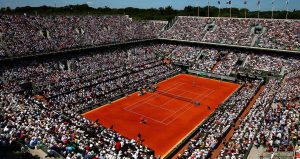
His run at Roland Garros is drawing the attention and with a dominating win against Khachanov on Sunday evening, he now faces Zverev in the Quarter Finals this afternoon. What’s exciting is seeing the next gen pulling through to the latter stages of Slams, with five players under 25 in the QF at Roland Garros. If Carlos takes the win, he will face Djokovic or Nadal, a match up which is sure to showcase what the future of tennis can do against its icons.
To learn more about the work we do within tennis or sports performance analysis, please feel free to get in touch at [email protected].
